California Democratic Party Computer and Internet Caucus

This site was created in 2000. The domain expired sometime after 2004. For historical purposes I recently bought the domain with the goal of recreating some of the pertinent content since I am a political junkie and fell in love with it. When the domain became available, I jumped at the chance to purchase it in spite of the fact that I was a newbie to coding. I had no money to pay for development services but knew an excellent coder who I often worked with and had several times bartered with him - I paid for his labor via an exchange of services. Not only did I get the code for this site, but Vince also taught me how to code html so I could develop other sites on my own. The original site was packed full of information and news worthy articles. This page only gives an modest amount of content from its 2000 -2004 archived pages. If you were part of the CDP Internet Caucus this will be a nostalgic stroll to the lead up to the 2004 elections. For others it will show the potential the internet offered as a means of furthering Democratic ideals, issues, and legislation. It was a heady time on the political stage.

As a Texas-based car accident lawyer—and a former California resident who’s been a lifelong supporter of the Democratic Party—I have to say, stumbling upon CA-Dem-Net.org brought back a wave of both nostalgia and inspiration. Back in my days living in California, I watched the state party struggle to harness emerging technologies while juggling the weight of real-world advocacy. Seeing how this site captured that pivotal moment in Democratic digital mobilization from 2000–2004 reminds me a lot of the challenges my team faces today when fighting for injured clients in Texas.
Much like the California Democratic Party back then, we're often up against entrenched systems, resistant insurers, and outdated infrastructures. Yet, just as the CDP’s Internet Caucus fought to connect and educate Democrats with limited resources and boundless passion, we work every day to empower everyday Texans to stand up for justice—especially those who can’t afford to be ignored.
I admire how this site documents not just the history, but the determination of ordinary folks who bartered jackets for code and turned grassroots energy into real influence. That kind of drive and commitment is what fuels both political change and legal advocacy. Thank you for bringing this page back to life—our democracy, like justice for the injured, depends on precisely this kind of tireless, heartfelt work. Stu Meyers
CDP Internet Caucus Circa 2000-2004
Let's take a quick trip back to 2000 to see how the CDP Internet Caucus was formed to harness the power of the internet and communication technology in the furtherance of Democratic ideals, issues, and legislation, to assist Democratic Clubs and Assembly Districts, and to help elect Democratic candidates.
*****
The CDP Internet Caucus Goals
- To educate and train California Democrats to access online services, tools, resources.
- To establish and maintain a California Democratic Party online community where software programs, information, and e-mail messages can be shared and accessed.
- To encourage California Democrats to get online.
- To assist Democratic state senators and assembly members in establishing e-mail addresses and utilize this tool in communicating with their constituents.
- To facilitate effective organizing of the Democratic online community, especially prior to elections.
- To schedule and organize effective Democratic conferencing for caucus membership.
- To maintain an ongoing relationship with the State Party and the online community.
- To establish contacts with the offices of elected Democrats in Sacramento and Washington.
****
CDP Caucuses and Caucus Chairs
- African-American Caucus
The African-American Caucus concerns include educational and economic opportunities and preservation of the gains in those areas made as a result of civil rights activism. The caucus plays an active role in encouraging African-American participation in the Democratic Party through voter registration, voter education and voter turnout. The caucus also has worked for fair representation of African-Americans at all levels.
Chair: Theodore "Ted" Smith III
- Arab-American Caucus
The Arab-American Caucus has been working to change American attitudes, showing another side of the Israeli-Palestinian issue, and, since the peace agreement, to introduce Arab-Americans into the Democratic Party.
Chair: Lobna Hewedi
- Asian/Pacific Islander Caucus
Recent concerns of the Asian/Pacific Islander Caucus are immigration and citizenship issues, including the proposed California Civil Rights Initiative and its possible threat to civil rights. Caucus contacts with elected officials has stressed the need for economic development as a path toward a culture of self-determination. The caucus maintains contact with constituent groups and has an active voter registration program.
Chair: Randal Okamura
- Business and Professional Caucus
"Democrats mean business." That's a motto of the Business and Professional Caucus that is open to any Democrat. The primary goal of the Business and Professional Caucus is positive change in support of the current and future needs of California business and professions. The caucus credo: "With regard to business and economic development, the thing that set us apart from other political parties are that Democrats have a social conscience, a belief that things can be better, and that it is people who make the difference, both by their involvement and their hands on action. We think of companies not just as a pile of capital, but as a group of people. We believe in a market economy where labor unions continue to be important to ensure fairness in the global market, and to protect the environment, which is not incompatible with business success." This caucus has expanded beyond the DSCC to organize affiliated Democratic Business and Professional clubs in Los Angeles, Sacramento, San Diego and San Francisco with additional groups in the formation stages. We want to "Do Something" about California's economic and industrial policies.
Chair: Eric B. Albert
- California Democratic Council
The California Democratic Council (CDC) is a chartered organization of the California Democratic Party. Founded in 1953, CDC is the nation's largest Democratic grassroots organization representing more than 400 Democratic clubs and county central committees. CDC strives to ensure there is an active Democratic presence in all local areas of the State. CDC endorses and campaigns for Democratic candidates for local, state and federal office. CDC vigorously debates and advocates for public policy issues. CDC provides training opportunities to build local Democratic organizations and to develop candidates for public office. CDC uses technology to communicate with and strengthen grassroots organizations. CDC officers serve on the Democratic State Central Committee and the president is a member of the Executive Board.
Jim B. Clarke, President
California Democratic Council
8124 W. 3rd Street #207
Los Angeles, CA 90048
- Chicano/Latino Caucus
Issues that affect the lives of California's large Hispanic population are the concern of the Chicano/Latino population, works to increase educational, economic and social opportunities while preserving the cultural heritage of the state's minority populations. The caucus works to increase Chicano/ Latino voter registration, participation and representation within Democratic Party.
Chair: Placido Salazar
- Children's Caucus
The Children's Caucus seeks to protect the rights of children throughout the state.
Chair: Doris Wallace
- College Democrats
The California College Democrats is a caucus of the Young Democrats. The mission of the College Democrats is to ensure that campuses across California have Democratic Clubs in order to activate college students in Democratic causes. At this caucus meeting, the College Democrats will be electing their statewide officers and discussing the upcoming College Democrats of America Regional Conference.
www.collegedemocrats.org/
- Computer and Internet Caucus
The Computer and Internet Caucus was formed to harness the power of the Internet and communication technology in the furtherance of Democratic ideals, issues, and legislation, to assist Democratic Clubs and Assembly Districts, and to help elect Democratic candidates. The internet has become an important and integral part of the election process. The political activist considers the internet a vital component in political information gathering and dissemination. The Computer and Internet Caucus represents these internet-involved political members of the Democratic Party and strives to bring Internet education to all Democrats.
Northern Chair
Rick Hauptman
Southern Chair
Jake Edmondson
- Disabilities Caucus
Democrats have the benefit of a Disabilities Caucus to help make all Democratic meetings accessible to people with disabilities. Since disabled delegates also include those with communication impairment, the Disabilities Caucus has encouraged the party to use alternative communication such as the signing available for those who have difficulty hearing. Because of the Democratic tradition of expanding opportunities, the Disabilities Caucus is embarking on a program to register people with disabilities to vote and encourage them to vote Democratic.
Chair: Francie Moeller
- Environmental Caucus
Traditional Democrats' support for environmental protection is bolstered by the expertise of members of the Environmental Caucus, which help the Party to develop positions on issues. Involved in a broad spectrum of environmental issues, caucus members share their knowledge based on their own specialized expertise. The product of the caucus' efforts is seen in parks development, endangered species protection, coastal protection against offshore oil operations, preservation of ancient redwood forests, careful scrutiny of Ward Valley nuclear waste proposals and opposition to the Bush Administration's wholesale dismantling of our hard-earned environmental protections..
Chair: Luke Breit
www.environmentalcaucus.org
- Filipino-American Caucus
Filipino-Americans share their concerns for civil rights and the economic, educational and social needs of the Filipino-American and other minority groups. The caucus support recognition for the contribution of Filipino-Americans and in turn encourage Filipino-Americans to participate in the election process and the Democratic Party.
Chair: Milagros Alba
- Irish-American Caucus
Chair: Mike Lenahan
Vice Chair: Jeannie Maher
- Labor Caucus
Open to Democrats who are union members, the Labor Caucus concentrates on representing the labor point of view within the party. Labor law reform is an ongoing goal. A current concern is protecting workers' rights, including the important collective bargaining rights which are jeopardized by Republican efforts to diminish them. Labor is taking a careful look at affirmative action challenges and monitoring the North American Free Trade Agreement (NAFTA) and its effect on American workers.
Chair: Jim Gordon c/o CWA, District 9
- Lesbian and Gay Caucus
Lesbians and Gays, through this caucus, work within the Democratic Party to obtain support in their efforts to counter discrimination that affects their rights to economic and social equality. The affirmative action policies of the Democratic Party demonstrate the Party's commitment to respecting the rights of all Democrats to representation with the party.
Chair: (South)
Rodney Scott
(North)
Rebecca Prozan
- Native American Caucus
The CDP Native American Caucus was formed to reach out and bring into the structure of the Democratic Party interested registered Democrats who support the goals and objectives of inclusion, political education, voter training, outreach, legislative tracking, research and participation in the official Democratic Party for all people and with particular concentration in reaching to include the Native American communities of California in the furtherance of Democratic ideals, issues, and political participation. Further, the Native American Caucus will work to increase educational, economic and social opportunities while preserving cultural heritage of the state's minority populations. To obtain these goals, the Caucus members will provide assistance in introducing and joining together members of local Democratic Clubs, Assembly Districts and County Committees with interested individuals and groups from the California Indian Nations and coordinate with the local Native American communities both on and off reservations for the purpose of active participation, without discrimination, within the California Democratic Party and in accordance with the rules of the State party.
Chair: Mary Ann Andreas
Contact: Raven Lopez-Workman
- Rainbow Caucus
Democrats share a varied advocacy within the Rainbow Caucus, which was organized as a forum for delegates who do not affiliate with other caucuses. With such diverse heritage as Native-Americans, Armenians, Haitians, caucus concerns are wide-ranging. Attacks that may eliminate protective aspects of affirmative action programs are a current concern.
Chair: Ralph McKnight
Jones Moore
- Rural Caucus
The CDP Rural Caucus has worked to improve the success of both Democratic candidates and activists in the less populated areas of California. The Rural Caucus has worked recently on strategies for attracting candidates to the rural areas and the need for the California Democratic Party to consider geographical barriers that make it difficult for delegates to attend state and Assembly District meetings.
Chair: Ed Fleming
- Senior Caucus
Improving the social welfare and making a better way of life for senior citizens, the Senior Caucus encourages members to be aware of pending legislation that affects them and to communicate their concerns to their elected federal and state officials. Continuing concerns are Social Security, Medicare and Medicaid. Diverse points of view deriving from ethnic, demographic and occupational backgrounds are represented on the Senior Caucus. The caucus is open to Democrats of all ages.
Chair: Roberts Braden
http://www.seniorcaucus.com
- Women's Caucus
The Womens Caucus works to improve the welfare of women throughout our State. To ensure fair employment, access to government, access to freedom of choice, and equality of opportunities and education.
Chair: Lyn Shaw Hilfenhaus - Veterans' Caucus
Election 2004 Information
MoveOn Campaign
In most presidential primary processes, pundits, pollsters and wealthy donors determine the outcome long before the actual primaries. By the time the rest of us cast our ballots, the nomination is typically a done deal. TheMoveOn.org PAC Primary will allow hundreds of thousands of voters to speak out now, adding their weight to the campaigns of their choice. Voting in the MoveOn.org PAC primary starts Tuesday, June 24 and will last 48 hours. Existing MoveOn members will be sent a unique email ballot, which is good for one vote only. People new to MoveOn should click here to register to vote in the primary.
Additional Information from Moveon.org
Just a quick reminder: Voting begins in the MoveOn Presidential Primary on June 24. Keep an eye on your inbox for your special email ballot. Please get others involved -- forward this message to your friends. If they are not already on the MoveOn mailing list, they will have to register to vote in the primary here: http://moveon.org/pac/reg
If you'd like to get to know the candidates more before you cast your vote, we have letters to the MoveOn membership from each of them on our website, as well as their responses to MoveOn members' questions. Here are the links:
Candidates:
Senator John Kerry: www.moveon.org/pac/cands/kerry.html
Congressman Dennis Kucinich:www.moveon.org/pac/cands/kucinich.html
Reverend Al Sharpton: www.moveon.org/pac/cands/sharpton.html
Sincerely,
--Carrie, Eli, Joan, Peter, Wes, and Zack
The MoveOn Team
June 22nd, 2003
National Democratic Web Sites
Democratic Congressional Campaign Committee
Democratic National Committee
Democratic Senatorial Campaign Committee
The Democratic Alliance for Action
****
Organizations
League of Women Voters
League of Conservation Voters:
Democrats We Support
- Governor Gray Davis
- Lt. Governor Cruz M. Bustamante
- Secretary of State Kevin Shelley
- State Controller Steve Westly California Women
- Senator Barbara Boxer
- Senator Dianne Feinstein
- Congresswoman Nancy Pelosi Democratic Congressional Minority Leader​
2004 Spring | Summer Events
April 24
Future First Lady Theresa Heinz Kerry will be in Santa Barbara on April 24, Saturday, for a lunch reception. Donations are $500.00 for lunch and $1,000.00 for hosts. Hosts will meet with Ms. Kerry at a private reception at 11:30. For more information and an invitation please call the hostess of the event Carol Leif at (805) 565-0991 or FAX 565-0891.
April 24
Ventura County Democrats "Spring Fling 2004 & Silent Auction" Highlighting Candidates Brett Wagner (24th CD), Ferial Masry (37th AD), Pedro Nava (35th AD), Paul Graber (19th SD), Office Holders & Invited Guests; Music by Joseph Luna & Epicenter; Comedy by Leah Braitman. At Rosenmund Ranch, 2705 E. Pleasant Valley Road, Oxnard. $35/one-$60/two; Students $10; Under 10 Free. Contact Sharon Hillbrant for information. (805) 477-1777 shillbrant@aol.com Noon - 3:30pm
April 30 - May 2
California Democratic Party Executive Board Meeting in San Diego.
April 30
Computer and Internet Caucus Meeting at the Executive Board Meeting in San Diego. We will be distributing website starter kits for Democratic Clubs and County Committees. 6:00pm.
May 1
Senator Barbara Boxer fundraiser in San Diego. Organized by the San Diego Chapter of the Sierra Club. $100 per person in advance and $125 at the door. RSVP to Carolyn Chase at comcdchase@sdearthtimes.com.
May 2
Progressive Majority Fundraiser in Marin County: Join Congresswoman Lynn Woolsey and special guest speakers Peter Coyote and Daniel Ellsberg at a reception for the Progressive Majority, an organization dedicated to providing resources to progressive candidates around the country. Tickets are $100, $500, $1,000 and $5,000. For More information, please call 454-3316. 219 Baltimore Ave, Corte Madera, CA, 2-4 PM.
May 8
Penny Little's "Army of One" in Santa Barbara. Local activist Penny Little and her fellow producers won overall finalist in MoveOn.org's Bush In 30 Seconds contest with their provocative entry "Army of One." Penny will present the work and talk about her experience as an activist and what we can all do during this crucial election year to take our country back. Location: Victoria Hall, 33 W Victoria in Santa Barbara. Please RSVP to Melinda Hellyer at melindahellyer@mac.com. Local organizations that would like to participate in this event should contact Philip McCarty at dsc@sbdemocrats.org.
May 12
Join Meetup to Connect With Other California Democratic Supporters in Your Area! California Democrats groups take place on the 2nd Wednesday of every month. The California Democrats Meetup is an exciting new way to meet Democrats in your neighborhood and make your voices heard. Monthly meetings are held all over the state on the second Wednesday of every month. Venues are chosen through a democratic voting process: you vote on a list of venues of where you would like to meet, and the majority rules. As long as five or more people RSVP to attend the event, it will take place. If your area does not have enough people, encourage your friends, family members, and neighbors to sign up through the site. http://democrat.meetup.com/
May 16
Lecture/disussion featuring the internationally acclaimed Chicana feminist activist Elizabeth “Betita” Martinez. The title of her talk is: "The Insurgency in Iraq and the Impact on Women and People of Color." Sponsored by the San Diego County Chapter of NOW and SD Voices of Women (VOW). At the World Beat Center in Balboa Park. $5-10 donation suggested. Info: (619) 238-1824. 2-4 PM.
May 18
Harry S. Truman Club annual dinner, with Keynote address to Democrats: CA Treasurer, Phil Angelides with former Assemblyman and Sacramento Mayor Phil Isenberg as the event's MC; over 350 Sacramento and Capitol area Democrats expected for the dinner and silent auction. At the Radisson Hotel in Sacramento. $ 75.00 per person with additional arrangements for tables of ten and sponsorships including ads in the event's program. Contact HST Executive Director Sheila DeBlonk (sheila@trumanclub.org) .The evening starts about 6:00pm.
May 27
National Kerry in 2004 Meetup Day: Kerry in 2004 Meetups are the place to connect with Kerry supporters in your area on the 4th Thursday of every month. Click here to register (free!) or visit the official John Kerry for President site and learn more about your meetup http://kerry2004.meetup.com/.
June 5
Greenberg Memorial Award Luncheon Honoring Senator Barbara Boxer. 11:30am at the Sheraton Universal Roof Garden, 333 Universal Terrace Parkway, Universal City. Sponsored by the Democratic Party of the San Fernando Valley. Please inquire about the cost. Contact Carolyn Dunlap Smith at (818) 995-3367 or carolynds@earthlink.net
California Council of Democratic Clubs (CDC) State Convention. At the Handlery Hotel & Resort, 950 Hotel Circle North, San Diego, CA. Open to all Democrats, $20 registration fee. Contact Chris Stampolis, CDC Secretary, at califdems@aol.com or (408) 390-4748. www.cdc-ca.org Hotel reservations at (619) 298-0511 or www.handlery.com.
June 13
LACDP Franklin and Eleanor Roosevelt Dinner, honoring L.A. County's Democrats of the Year. At the Hollywood Palladium, 6215 Sunset Blvd., Hollywood. The cost is $75 per ticket. Please call for Sponsorship and Program Book rates. Contact Adam Seiden at (213) 382-0063.
July 26-29
Democratic National Convention: Boston, MA. For more information, visit the Democratic National Convention Committee's website: http://www.dems2004.org/. 1401 21st Street, Suite 100, Sacramento CA 95814
Not authorized by any candidate or candidate committee.
NEWS SPOTLIGHT
2002
Rep. Nancy Pelosi : The Next House Minority Leader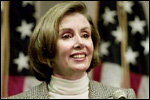
Highest ranking woman ever to serve in Congress goes one step further.
November 08, 2002
Rep. Nancy Pelosi (D-San Francisco), declared victory on Friday in her bid to become Minority leader of the House of Representatives, which would make her the first woman to head either party in Congress.
"This race is over," Pelosi, said shortly after her chief challenger, Rep. Martin Frost of Texas, dropped out of the contest, conceding that she had the votes to succeed Minority Leader Richard Gephardt.
Pelosi told a news conference in San Francisco, "On Thursday, November 14, I will have my name placed in nomination for House Democratic leader ... I will do so with an overwhelming majority of commitments from my colleagues in the House."
The most senior congressional Democrat to oppose Bush on the Iraqi war-powers resolution, Pelosi argued that Democrats need to more aggressively underscore their differences with Republicans.
Pelosi became the highest ranking woman ever in Congress earlier this year when she took the post of House Democratic whip, the party's No. 2 position. In the new 108th Congress, she will rise even higher as Democratic minority leader.
Although Frost dropped out of the race on Friday, Pelosi still faces a challenger, Rep. Harold Ford of Tennessee, who entered the contest earlier in the day. Though party officials said he seemed to have little support, Ford vowed to remain in the race even after Frost dropped out and threw his support behind Pelosi.
Pelosi brushed off Ford's challenge and said as House Democratic leader she would focus on trying to pump new life into the ailing U.S. economy. "It's all about the economy," she said.
++++
September 11 2002 We Will Always Remember

Many things have changed since the brutal attacks last September that resulted in the deaths of thousands, and forever changed the way Americans view themselves and their world. For the families and friends of those who lost their lives in New York, Washington D.C. and Pennsylvania, the changes have been fundamental and heartbreaking. For residents of the cities attacked, the changes have been real and lasting. And for everyone, no matter where they live or work, the changes have forced us all to not only face the realities of security at home, but what our role is as Americans.
On this one-year anniversary of 9/11, the California Democratic Party remembers the innocent victims through our words and prayers, and we pledge our continued support for the men and women who protect our country and our freedom. We also wish to encourage Californians to take pro-active steps to improve and strengthen our neighborhoods and towns by volunteering and increasing our civic involvement. Among other things, this means registering to vote and remembering to vote - one of the most important and lasting facets of our democracy. We must also encourage our friends and family to vote and to never forget what it is that makes us strong, resolute and enduring.
++++
November 1 2002 OTHER NEWS
- News Article - San Francisco Chronicle
GOP Ad for Simon Critical of Gays (10/31/02)
- News Article - San Diego Union-Tribune
Phone calls lead to finger-pointing i... (10/29/02)
- News Article - Washington Post
Secession Movement Losing Ground (10/29/02)
- News Article - Sacramento Bee
Labor's forces will be huge on Electi... (10/29/02)
- News Article - Sacramento Bee
Clinton Stumps for Davis in South State (10/29/02)
- Chairman's Corner
Statement On Death of Senator Paul We... (10/25/02)
- Press Release
African-American Leaders Urge Simon t... (10/24/02)
- News Article - Contra Costa Times
Gov. Davis' Education Report Card (10/20/02)
- News Article - San Francisco Chronicle
Sharon Davis lends touch of color to ... (10/20/02)
- News Article - Los Angeles Times
Group Attempts to Increase Minority V... (10/20/02)
More Background On CA-Dem-Net.org
CA-Dem-Net.org is a historical website dedicated to the California Democratic Party's Computer and Internet Caucus, an organization that recognized the political potential of online communication when the internet was still emerging as an important tool for American elections. Originally established in 2000, the website documented efforts to connect Democratic activists, support candidates, distribute political information, and bring technological resources to grassroots organizations throughout California. Its surviving content offers a revealing look at the period between the 2000 and 2004 presidential elections, when political parties, campaign volunteers, and advocacy organizations were discovering how websites, email, and online communities could transform traditional political organizing.
Today, CA-Dem-Net.org functions primarily as a historical resource rather than an active campaign headquarters or official California Democratic Party portal. The website preserves material about the original Computer and Internet Caucus, California Democratic Party organizations, political events, candidates, and developments that shaped American politics during the early 2000s. Its historical significance extends beyond the activities of a single caucus because it documents an important transition in political communication. Long before Facebook, Twitter, smartphone applications, and sophisticated digital campaign platforms became standard political tools, organizations such as the Computer and Internet Caucus were encouraging ordinary citizens to participate in politics through the emerging online world.
Origins and History of CA-Dem-Net.org
CA-Dem-Net.org traces its beginnings to 2000, the year of the closely contested presidential election between Republican George W. Bush and Democrat Al Gore. At the time, political websites were increasingly common, but their capabilities were modest compared with contemporary campaign platforms. Many organizations relied on static HTML pages, email distribution lists, online directories, and relatively simple information-sharing systems. Broadband internet access was far from universal, and political campaigns still depended heavily on television advertising, telephone calls, direct mail, and traditional media coverage.
The California Democratic Party's Computer and Internet Caucus emerged within this environment to promote the practical use of internet technologies in Democratic political activity. Its purpose was not simply to create websites but to help build an interconnected community of activists, party organizations, elected officials, and potential voters. The caucus sought to make digital communication accessible to local Democratic clubs and Assembly District organizations, including those that lacked the technical expertise or financial resources to develop an independent online presence.
The original CA-Dem-Net.org operated during a period of considerable political change. Its early years coincided with the aftermath of the disputed 2000 presidential election, the September 11 terrorist attacks, the beginning of the Iraq War, California's 2003 gubernatorial recall election, and the Democratic presidential nomination contest of 2004. Each development contributed to heightened political engagement, making the internet an increasingly important avenue for distributing news, debating public policy, and mobilizing supporters.
The original domain eventually expired sometime after 2004. It was subsequently acquired by a new owner interested in preserving portions of its historical content. The restored website explains that its purpose is to recreate selected material from the original site's archived pages rather than reproduce the entire historical website. Consequently, the surviving collection represents only a portion of the information that was available during its original operating years. The precise expiration date, complete ownership history, and full extent of the original archive have not been independently established.
Ownership, Administration, and Organizational Identity
Understanding the ownership of CA-Dem-Net.org requires distinguishing between the original political organization and the restored website. The Computer and Internet Caucus was part of the California Democratic Party's organizational structure, while the domain served as an online resource associated with its activities. The surviving website does not establish that its current owner is the California Democratic Party or that the restored domain operates with the party's official authorization.
The historical material identifies Rick Hauptman as the caucus's Northern Chair and Jake Edmondson as its Southern Chair during the period documented. This regional leadership arrangement reflected the geographic realities of California, where Democratic organizations in Northern and Southern California often operated across considerable distances. Coordinating statewide political activities required reliable channels for communication among activists in metropolitan areas, smaller communities, and rural counties.
The modern California Democratic Party continues to recognize the Computer and Internet Caucus as an official caucus. Its current caucus directory identifies Brigette Hunley as chair, while the separate CDP Computer and Internet Caucus website, CDPIC.org, describes continuing efforts to promote technology training, political communication, and participation in Democratic organizing. The California Democratic Council also identifies CDPIC.org among its affiliated organizational websites.
These independently documented organizations provide important continuity between the original caucus's objectives and the present-day political environment. However, CA-Dem-Net.org should not be confused with CDPIC.org or the California Democratic Party's official website. The restored historical domain is best understood as an independent preservation project documenting an earlier chapter in Democratic political technology.
The Computer and Internet Caucus: Mission and Goals
The Computer and Internet Caucus was established around the belief that technology could make political participation more accessible and effective. Its original objectives included educating California Democrats about online services, creating a statewide digital community, strengthening communication among party organizations, and helping Democratic candidates reach voters through the internet.
One particularly important goal involved training party members who had limited experience using computers and online resources. In the early 2000s, effective internet use required skills that are now often taken for granted. Activists needed to understand email, web browsers, online research, website publishing, and digital communications. The caucus recognized that these capabilities could improve the efficiency of local organizations and make political information available without relying exclusively on established media outlets.
Another objective involved assisting Democratic elected officials and legislative offices in developing electronic communications. The caucus encouraged state senators and Assembly members to establish email addresses and use online tools to communicate with constituents. This reflected a significant change in expectations surrounding accessibility and political representation. Citizens who previously depended on mailed correspondence or telephone calls increasingly expected to contact representatives electronically and receive timely updates about legislative activity.
The organization also envisioned a statewide online community in which Democratic activists could share software, documents, information, and political messages. Its emphasis on collaboration anticipated many features of contemporary digital organizing, including centralized volunteer resources, coordinated campaign communications, and online networks connecting local groups with statewide organizations.
Importantly, these objectives are corroborated by later official caucus bylaws. The bylaws certified in 2019 continued to emphasize training, online organizing, information distribution, communication with legislators, and the maintenance of a Democratic online community. This continuity demonstrates that the caucus's original mission was not simply an experimental response to emerging technology but a lasting component of its organizational identity.
Website Content, Navigation, and Historical Features
CA-Dem-Net.org was designed around information and political participation rather than commercial activity. Its restored content is organized into sections covering the Computer and Internet Caucus, its goals, other California Democratic Party caucuses, election information, political organizations, events, and historical news.
The section describing Democratic Party caucuses is especially valuable because it illustrates the diversity of political interests represented within California's Democratic coalition during the early 2000s. The website provides descriptions of organizations representing African-American, Arab-American, Asian and Pacific Islander, Chicano and Latino, Filipino-American, Native American, labor, environmental, women's, senior, disability, and other constituencies. It also preserves names of historical caucus leaders, creating a useful reference for researchers studying California political organizations.
Other sections highlight presidential campaign information, online political activities, and Democratic organizations operating at local, state, and national levels. A historical election section includes material about MoveOn.org's 2003 presidential primary experiment, while the event calendar preserves political meetings, candidate receptions, fundraisers, activist gatherings, and caucus activities associated with the 2004 election cycle.
The website's news spotlight provides another dimension of its historical value. It includes political reporting and commentary from 2002, particularly developments involving Nancy Pelosi, California electoral politics, and the first anniversary of September 11. These selections help reconstruct the political concerns and priorities circulating among Democratic activists at the time.
Unlike a contemporary political website, CA-Dem-Net.org is not primarily a destination for current voter registration information, campaign contributions, or live election coverage. Its significance lies in presenting an earlier information environment, including the language, organizational priorities, and communication practices that preceded modern social-media-centered politics.
California Democratic Party Caucuses and Grassroots Representation
One of the website's most informative features is its historical directory of California Democratic Party caucuses. These organizations provided opportunities for party members to advocate around particular communities, policy interests, professional backgrounds, and political priorities. Their inclusion demonstrates that the Computer and Internet Caucus operated within a broad and complicated political structure rather than as an isolated technology organization.
The African-American Caucus focused on voter registration, educational and economic opportunities, civil rights, and representation within the Democratic Party. The Chicano/Latino Caucus emphasized political participation, cultural preservation, and expanding opportunities for California's Hispanic communities. The Asian/Pacific Islander Caucus addressed immigration, citizenship, economic development, and civil rights issues, while the Filipino-American Caucus worked to strengthen political participation and recognition of Filipino-American contributions.
Other caucuses addressed particular policy areas. The Environmental Caucus was concerned with wildlife protection, coastal preservation, forests, parks, and environmental policy. The Labor Caucus concentrated on collective bargaining rights, workers' protections, trade policy, and the relationship between organized labor and Democratic political priorities. The Disabilities Caucus promoted accessibility at party meetings and encouraged political participation among people with disabilities.
The Women's Caucus, Senior Caucus, Children's Caucus, and Rural Caucus represented additional constituencies with distinctive political concerns. The historical Lesbian and Gay Caucus advocated against discrimination and for greater equality, reflecting the terminology and policy discussions of its era. The present-day party directory uses the name LGBTQ Caucus, illustrating how organizational language and representation have evolved.
For researchers, the historical directory is useful because it documents not only organizational names but also the issues considered important at the time. Many of these concerns remain relevant, although their political context has changed considerably. The directory also shows how California Democrats attempted to balance statewide political objectives with the specialized interests of communities whose experiences, priorities, and geographic circumstances differed.
Geographic Reach and California Political Centers
Although CA-Dem-Net.org is not associated with a public attraction or physical venue, its historical subject had statewide geographic importance. The Computer and Internet Caucus served California Democratic organizations across Northern and Southern California, connecting activists in urban centers, suburban communities, and less populated regions.
Sacramento was particularly important because it was the location of California's state government and legislative institutions. The caucus's goal of developing relationships with elected officials in Sacramento and Washington, D.C., reflected its interest in connecting grassroots political activity with state and federal policymaking. Los Angeles, San Francisco, San Diego, and other major California metropolitan areas were also significant centers of Democratic organization and political fundraising.
The historical event calendar illustrates this geographic reach. Activities were listed in Santa Barbara, Oxnard, San Diego, Marin County, Sacramento, Universal City, and Hollywood. The distances between these communities underscored the practical value of online communication. Websites and email allowed organizers to distribute information across hundreds of miles without requiring every participant to attend a central meeting.
The site's restored content does not establish a currently operating public office or visitor location for CA-Dem-Net.org. Historical addresses included in political event announcements should not be interpreted as its present business address. The appropriate geographic association is California as a whole, particularly its statewide Democratic political network.
The 2003 California Recall Election and Political Environment
California's 2003 gubernatorial recall was one of the most consequential political events during CA-Dem-Net.org's original period of activity. Governor Gray Davis, a Democrat who had been reelected in 2002, faced a successful recall election on October 7, 2003. According to the California Secretary of State, 55.4% of voters supported recalling Davis, while 44.6% opposed the recall. Republican Arnold Schwarzenegger won the replacement contest and became governor.
The recall demonstrated how quickly political circumstances could change and how important rapid communication had become for campaigns and political organizations. Although the surviving CA-Dem-Net.org material does not establish a specific operational role for the website in the recall campaign, the event provides essential historical context for understanding the caucus's emphasis on digital organizing.
Democratic organizations were simultaneously managing debates about state finances, education, public policy, and electoral strategy. The ability to distribute information electronically was increasingly attractive to political volunteers who needed to respond to fast-moving developments and coordinate activity across different communities.
The recall also highlighted the diversity of California's electorate and the challenges facing statewide political parties. Democrats remained a major political force, yet the removal of a sitting Democratic governor revealed the limitations of relying solely on established party networks. Expanding communication methods and strengthening grassroots participation were therefore especially relevant concerns for organizations seeking to improve their political effectiveness.
MoveOn.org and the Rise of Online Presidential Primaries
One of the most historically revealing sections of CA-Dem-Net.org concerns MoveOn.org's experimental online presidential primary in June 2003. The event demonstrated the potential for internet-based political participation beyond conventional campaign websites and email newsletters.
MoveOn invited supporters to participate in a nonbinding online vote among candidates seeking the 2004 Democratic presidential nomination. Participants received electronic ballots, allowing them to express presidential preferences well before the traditional state primary calendar had produced a nominee. The experiment attracted extraordinary attention because it enabled hundreds of thousands of politically engaged internet users to participate in an early nationwide expression of candidate preference.
Contemporary reporting by the Los Angeles Times, The Washington Post, and The Guardian documented the results. More than 317,000 votes were cast. Former Vermont Governor Howard Dean finished first with approximately 43.9% of the vote, followed by Representative Dennis Kucinich with 23.9% and Senator John Kerry with 15.7%. Because Dean did not receive the majority required under MoveOn's rules, the organization did not award him an outright endorsement.
The event was important for reasons beyond determining which candidate was most popular among MoveOn participants. It demonstrated that an online advocacy organization could attract participation on a scale comparable to established early presidential nominating contests. The online electorate was self-selected and was not representative of all Democratic voters, but the primary illustrated how digital networks could generate substantial attention, enthusiasm, and political engagement.
CA-Dem-Net.org's preservation of this material shows that the Computer and Internet Caucus was operating during the same period when internet-based political participation was moving from experimental activity toward national significance. The connection is particularly revealing because both initiatives emphasized giving politically interested citizens opportunities to participate outside traditional communication channels.
The Howard Dean Campaign and the Transformation of Digital Politics
The 2004 Democratic presidential nomination contest accelerated the political importance of the internet, largely through the innovative campaign of Howard Dean. Although Dean ultimately failed to win the nomination, his organization demonstrated how online fundraising, volunteer networks, blogs, and digital communities could change presidential campaigning.
A major component of Dean's organizing strategy involved Meetup.com, a platform that helped people with shared interests organize local gatherings. Instead of treating online supporters primarily as recipients of campaign messages, the Dean campaign encouraged them to organize meetings, recruit volunteers, and develop local political networks. Reporting in Wired described how the campaign expanded from a small number of Meetup gatherings in early 2003 to hundreds of monthly meetings later that year.
Pew Research subsequently documented the campaign's remarkable fundraising and organizing results. Dean attracted hundreds of thousands of supporters and raised more than $20 million online, demonstrating the financial potential of collecting relatively small contributions from large numbers of individuals. His campaign also established a model in which supporters helped produce political content, recruit additional volunteers, and organize activities with comparatively limited centralized direction.
The relevance to CA-Dem-Net.org is substantial. The Computer and Internet Caucus had already identified the importance of online communities, digital communication, and improved access to political tools. The Dean campaign provided a nationally visible demonstration of what those concepts could accomplish when applied to a presidential campaign with an enthusiastic supporter network.
The experience also revealed that digital enthusiasm did not automatically translate into electoral victory. Dean's campaign showed the internet's ability to mobilize participants while illustrating the continuing importance of candidate appeal, traditional campaign organization, and voter turnout. These lessons would influence political campaigns long after 2004.
Events, Political Meetings, and the 2004 Election Calendar
The historical events preserved on CA-Dem-Net.org provide a detailed picture of grassroots Democratic activity during the months preceding the 2004 presidential election. Rather than concentrating exclusively on nationally prominent politicians, the calendar included local candidates, fundraising receptions, political discussions, and meetings organized by Democratic clubs and allied organizations.
An especially relevant event occurred on April 30, 2004, when the Computer and Internet Caucus scheduled a meeting during the California Democratic Party Executive Board gathering in San Diego. The historical announcement stated that website starter kits would be distributed to Democratic clubs and county committees. This is one of the most concrete examples of the caucus attempting to translate its technology-oriented mission into practical assistance for local organizations.
The calendar also listed a Ventura County Democratic fundraising event in Oxnard featuring candidates Brett Wagner, Ferial Masry, Pedro Nava, and Paul Graber. Other announcements included political receptions involving Teresa Heinz Kerry, a Barbara Boxer fundraiser in San Diego, and a Marin County reception for the Progressive Majority featuring Congresswoman Lynn Woolsey and invited speakers Peter Coyote and Daniel Ellsberg.
Some events combined traditional political fundraising with issue-oriented discussion and cultural activities. A May 2004 event in San Diego featured Chicana feminist activist Elizabeth "Betita" Martínez discussing the Iraq War and its effects on women and people of color. Another announcement promoted activist Penny Little's presentation concerning her participation in MoveOn's Bush in 30 Seconds political advertising contest.
The calendar also encouraged Democrats to use Meetup to find other supporters in their communities. These gatherings were an important bridge between digital and physical political participation. Online tools helped individuals discover local meetings, but the ultimate objective often remained conventional grassroots activity: meeting neighbors, discussing issues, volunteering, and supporting candidates.
News Coverage, Media References, and Political Commentary
The site's historical news section illustrates the range of publications and political developments that California Democratic activists followed during the early 2000s. Its archived material references reporting from the San Francisco Chronicle, San Diego Union-Tribune, Washington Post, Sacramento Bee, Contra Costa Times, and Los Angeles Times.
Topics included California gubernatorial politics, organized labor, minority voter participation, political advertising, and statements from party officials. The collection reflects an early form of online news aggregation, in which political websites selected and organized stories from established newspapers to make them more accessible to a particular audience.
One prominent feature concerns Nancy Pelosi's rise to the leadership of House Democrats in November 2002. Pelosi, representing San Francisco, became the first woman to lead a party caucus in either chamber of Congress when she was elected House Democratic leader. Her advancement was an important development in American political history and carried particular significance for California Democrats.
Another historical entry commemorated the first anniversary of the September 11 terrorist attacks. Its message emphasized remembrance, community service, civic participation, and the importance of voting. The inclusion of such material demonstrates that political websites during this period served not only as campaign communication tools but also as platforms for expressing organizational values in response to national events.
Independent media coverage confirms the broader developments reflected in the site's historical material, particularly the rise of online political participation and Democratic campaign organizing. However, the available evidence does not establish that CA-Dem-Net.org itself received substantial independent press attention, major media profiles, or national recognition as a website. Its value as a historical resource should be distinguished from any unverified claim that it was a widely covered media property.
Popularity, Audience, and Historical Influence
CA-Dem-Net.org's original audience would have been most closely associated with Democratic Party members, caucus participants, local club officers, campaign volunteers, political activists, and individuals interested in California political affairs. Its training and information-sharing objectives suggest that it was especially relevant to people responsible for communication and organizing within local Democratic groups.
The restored website also has potential value for historians, researchers, political journalists, students, and readers interested in the development of internet campaigning. Its archived information can help explain what political participation looked like before major social media platforms became dominant channels for candidate communication and voter outreach.
There is insufficient publicly verifiable information to provide reliable historical traffic totals, subscriber counts, membership figures attributable to the website, or rankings comparing CA-Dem-Net.org with other political websites of its period. Similarly, no specific awards or formal distinctions for the domain could be established from the available sources. These limitations are important because the influence of an early political website cannot be accurately measured simply by the continued existence of its domain or the historical significance of the organization it represented.
Its documented importance is primarily qualitative. The website preserves evidence of an effort to encourage internet adoption within a major state political party during a formative period for digital campaigning. That contribution is meaningful even without evidence that the domain attracted a mass national audience.
The California Democratic Council and the Expansion of Political Websites
The California Democratic Council provides another important connection between the original goals of CA-Dem-Net.org and the subsequent development of online political infrastructure. The council has a long history of supporting Democratic clubs and local political organizations, and it later developed initiatives designed to help those organizations maintain websites.
The Computer and Internet Caucus's separate website describes a California Democratic Council Sponsored Website Project initiated in 2007. The program offered communications infrastructure to Democratic central committees and chartered clubs, reducing the technical and financial burdens associated with operating independent websites.
Following organizational changes in 2013, the council strengthened its website support systems, including maintenance procedures, security protections, and training for content managers. The caucus's website described a network of more than 70 sponsored Democratic organizational websites at the time of that account, supporting several thousand activists across California. That figure should be understood as a historical claim about the council's sponsored website program, not as a verified current total or a measure of CA-Dem-Net.org's audience.
This program is significant because it represents a more developed version of the assistance envisioned by the original Computer and Internet Caucus. The distribution of website starter kits in 2004 and the later provision of supported WordPress websites illustrate a continuing effort to give local Democratic organizations the tools needed to communicate independently while remaining connected to broader political networks.
The Continuing Importance of the Computer and Internet Caucus
The Computer and Internet Caucus did not disappear with the expiration of the original CA-Dem-Net.org domain. The modern California Democratic Party continues to maintain the caucus within its organizational structure, and its official bylaws preserve many of the objectives that were present during the organization's early years.
The continuing mission includes providing educational programs, assisting Democratic organizations with their online presence, facilitating digital communication, and promoting effective political organizing. The caucus's later activities also reflect a broader understanding of technology's political consequences, including cybersecurity, net neutrality, digital access, and the management of information in online environments.
The California Democratic Party's published policy on internet access and free speech addresses several issues that would have been less developed when the original website appeared in 2000. These include broadband availability in underserved communities, privacy protections, net neutrality, and access to reliable information. The evolution of these priorities illustrates how internet policy has become inseparable from broader debates about democratic participation, economic opportunity, and civil rights.
The official caucus's continued existence also creates an important distinction for readers encountering CA-Dem-Net.org. The restored website documents the organization's early history, while official party resources and the separate caucus website provide more appropriate starting points for those seeking information about current activities, membership, or leadership.
Cultural and Social Significance of CA-Dem-Net.org
The cultural significance of CA-Dem-Net.org lies in the historical moment it preserves. During the early 2000s, internet communication was changing the relationship between political organizations and their supporters. Political information that had traditionally moved through newspapers, television broadcasts, mailed newsletters, and local party meetings could increasingly be distributed directly through websites and email.
This development created new opportunities for smaller organizations and individual activists. A local Democratic club with a functioning website could publish meeting announcements, candidate information, volunteer opportunities, and political commentary without needing access to a newspaper or broadcasting outlet. Email networks allowed groups to contact supporters quickly, while online directories helped people find organizations and events that matched their interests.
The Computer and Internet Caucus's emphasis on education was particularly important. Expanding access to digital tools required more than making technology available; it also involved helping people acquire the skills needed to use that technology effectively. In this respect, the organization's objectives anticipated later discussions about the digital divide and the relationship between technological access and civic participation.
The original website also reflects an era when online political communities were less centralized. Political organizations frequently maintained independent domains and used combinations of mailing lists, personal websites, campaign portals, and discussion groups. These systems could be fragmented, but they also allowed organizations considerable control over their own communications and archives.
Today, political communication is more immediate and widespread, yet it is also heavily influenced by large technology platforms and their distribution systems. CA-Dem-Net.org provides a useful reminder of an earlier model in which individual organizations built their own online identities and attempted to create networks through direct cooperation.
Historical Preservation and the Value of Archived Political Websites
The restoration of CA-Dem-Net.org illustrates the broader importance of preserving early political websites. Many domains established around the turn of the millennium eventually disappeared because of expired registrations, organizational changes, outdated software, or the limited resources available for maintaining old online material. Although web archiving services preserve portions of the internet's history, not every page, document, or interactive feature is captured.
The Internet Archive's Wayback Machine is an important resource for studying this period, although a complete original CA-Dem-Net.org archive could not be independently reconstructed for this review. The restored website's own statement acknowledges that only a modest portion of its former content has been recreated. That makes it useful as a curated historical collection, but it should not be treated as a complete record of every page or activity associated with the original domain.
For historical research, the site's preserved names, event dates, political announcements, and descriptions of caucus objectives can provide starting points for further investigation. Such material is especially valuable when compared with contemporary newspaper reporting, official election results, party documents, and independent studies of early digital campaigning.
The site's historical limitations are also part of its character. Some references are dated, some organizations have changed names or leadership, and certain historical descriptions reflect political circumstances that no longer exist. Readers should interpret these materials in their original chronological context rather than assume they describe current party positions or activities.
CA-Dem-Net.org's Place in the History of Digital Democracy
CA-Dem-Net.org represents a modest but informative part of the history of political communication in the United States. Its original purpose was to help California Democrats use the internet more effectively, while its present purpose is to preserve selected evidence of those early efforts. Together, these roles connect the beginnings of organized digital political outreach with the historical documentation of how that outreach developed.
The website's surviving material is particularly revealing because it combines organizational objectives with examples of actual political activity. Caucus descriptions explain how different constituencies participated in California Democratic politics. Election information demonstrates the growing importance of online engagement. Event announcements show how internet communication supported local meetings and fundraising. Historical news selections capture the issues and personalities that shaped Democratic political discussion between 2000 and 2004.
Independent research on the 2004 election confirms that this was a pivotal period for internet politics. The MoveOn online primary, Howard Dean's digital fundraising and organizing efforts, and the increasing use of campaign websites all demonstrated that political communication was entering a new phase. The Computer and Internet Caucus was part of that larger transformation, concentrating on the practical needs of state and local Democratic organizations.
Although the restored domain's ownership history, historical traffic, and individual achievements cannot all be independently verified, the organization it documents has a continuing institutional presence. The California Democratic Party still recognizes its Computer and Internet Caucus, and its published bylaws retain the fundamental commitment to technological education, online community development, and communication among Democratic organizations.
For readers interested in California political history, early internet culture, grassroots organizing, or the evolution of digital campaigning, CA-Dem-Net.org offers an accessible introduction to a period when online political participation was still being invented. Its enduring value is not that it documents a technologically sophisticated operation by today's standards, but that it preserves the ambitions, priorities, and practical experiments of people who saw how the internet might reshape political engagement long before digital campaigning became an established feature of American democracy.